- Simplified AI: Stay Ahead in the AI Revolution 🚀
- Posts
- 🍿 OpenAI's dirty math feud exposed
🍿 OpenAI's dirty math feud exposed
Plus, The ChatGPT movie gets first trailer
In partnership with


Welcome back, AI Admirers!
Breaking News: An NYU mathematician claims OpenAI pressured him to remove a co-author from a breakthrough paper simply because the colleague worked at rival firm Anthropic.
Get ready to dive into the latest happenings in AI.
📢 Today's Headline:
NYU scholar calls out OpenAI
Andrew Garfield plays Sam Altman
AI Can Detect Diabetes From Facial Videos
$1.9B federal loan brings Iowa nuclear back
Latest AI Tools & Resources
Today’s Poll and Results
Read time: 4.0 minutes!
1 Year Claude Pro [FREE]
3,000+ AI tools. 1000+ prompts. All from one newsletter.
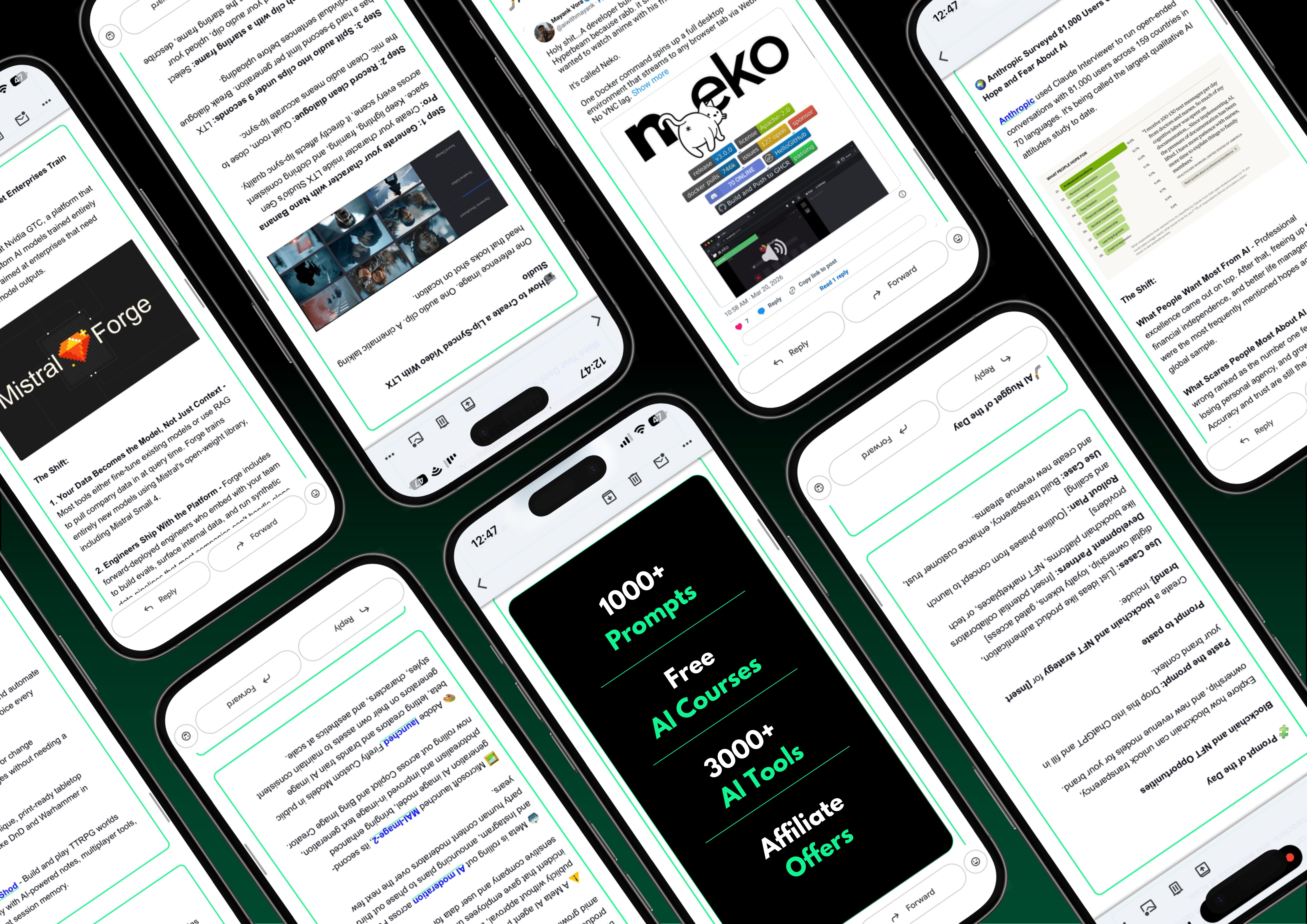
Most AI resources are scattered, untested, or buried behind a paywall.
The Shift puts it all in one free newsletter, covering what’s new, and what practically works under 5 minutes a day.
A vault of 3,000+ vetted tools so you’re never guessing. A 1000+ prompt library for every use case you’ll actually hit and free AI courses that make sure nothing stays theoretical.
Plus, right now, 3 subscribers win a free 1-year Claude Pro subscription just for signing up.
Hand-picked News
OpenAI is facing heat from NYU mathematician Tristan Buckmaster, who claims the company acted unethically during a breakthrough on the $1 million Navier-Stokes Millennium Prize problem.
The co-author ultimatum: Buckmaster says OpenAI offered to give him credit on an AI-assisted math proof, but only if he dropped his co-author, Levent Alpöge, because Alpöge works at rival lab Anthropic.
Privacy concerns: The researchers used OpenAI's Codex to draft preliminary work. Shortly after, OpenAI announced its own model made the same breakthrough, raising suspicions that private user prompts were monitored or used to jumpstart internal research.
Massive compute burn: Once OpenAI heard rumors of Anthropic's potential breakthrough, it reportedly spent millions of dollars running thousands of AI agents continuously for nearly 90 hours to secure the discovery first.
OpenAI denies reading private user data, maintaining that its team acted independently to formalize the proof.
The takeaway: Corporate warfare is entering academic research. If you are working on sensitive projects or proprietary IP, do not input unannounced breakthroughs into cloud-hosted AI tools, as privacy guarantees may not protect you from corporate interests.
Hollywood is turning real-time Silicon Valley board disputes into prestige cinema before the ink on the news reports even dries.
The Hollywood Shift: Neon released the teaser for Artificial, a Luca Guadagnino film starring Andrew Garfield as Sam Altman, focusing on the 5 chaotic days in late 2023 when Altman was fired and reinstated.
The Conflict of Interest Drop: Amazon MGM originally backed the film but dropped it right around closing a $50B partnership with OpenAI, forcing indie distributor Neon to take the wheel.
Wild Ensemble Cast: Beyond Garfield, the cast includes Yura Borisov as Ilya Sutskever, Ike Barinholtz as Elon Musk, Monica Barbaro as Mira Murati, and Mark Rylance as Geoffrey Hinton.
Written by SNL alum Simon Rich, the film spans roughly two decades of machine-learning history culminating in the November 2023 boardroom coup. It premieres at the New York Film Festival in October before hitting theaters nationwide on Christmas Day.
Keep an eye out for how tech giants navigate media representation as corporate drama goes pop culture mainstream.
Researchers in Japan have developed an AI system that can screen for high blood pressure and diabetes using a five-second video of your face.
High accuracy: The algorithm detected hypertension with over 90% accuracy and diabetes with 81% accuracy across test participants.
Non-invasive monitoring: Instead of blood draws or inflatable arm cuffs, a specialized camera captures subtle, invisible micro-changes in blood flow and pulse-wave dynamics in your face.
Catching silent conditions: Hundreds of millions of people live with undiagnosed cardiovascular issues. Passive, video-based scanning could make routine checks effortless.
The system is not ready to replace traditional clinical equipment yet, as researchers need to test it on larger, more diverse populations to fix measurement variability.
The takeaway: Contactless health monitoring is moving toward everyday consumer hardware. Expect to see similar optical-sensing tech built into smartphones, laptops, and smart mirrors in the near future.
Quick Hits
🔥 New Tools & Resources
🔥 Kombai Gallery - 20,000+ curated UI designs for agents and humans
🔥 OpenMarket - Multi-agent marketplace where proof decides who wins
🔥 Gamma - Create unlimited presentations, websites, and more in seconds
🔥 Unlimited Prompts - Get 10k+ ChatGPT prompts now
🔥 Knockin' - Turns your static bio into an AI business card that replies
From our Partner
Join Fin, Anthropic, and Clay at Pioneer on October 7th

Pioneer, the summit where CX leaders redefine what’s possible, is on October 7th.
Join leaders from Fin, Anthropic, and Clay for an insightful conversation on the state of AI transformation.
You’ll discover how some of the most innovative minds in CX have transformed their organizations, learn how they think about CX, and hear how they're planning for what's next.
Join the conversation in San Francisco, or tune in virtually.
🚨 Quick Poll
Today’s Poll:
Would you actually watch a Christmas Day movie about Sam Altman and OpenAI drama? |
Vote today, see the results tomorrow!
Previous Poll:
With physical lens controls coming to smartphones, will this feature make entry-level DSLR cameras completely obsolete?
A) Yes – Smartphones just killed basic DSLRs. – 50% 🏆
B) No – Dedicated camera gear always wins. - 50% 🏆
This result nails the vibe: people are split right down the middle, which means smartphones are finally being taken seriously as “real cameras.” The bigger story isn’t specs — it’s identity, with creators now choosing sides between being a phone-first shooter or a camera purist.
The Only AI You Ever Need
Your ideas deserve to be seen. Gamma helps you turn them into presentations, websites, and content in minutes — no design bottlenecks, no blank page stress.
📌 Key Features
Presentations: Build polished decks, export to PPT or PDF.
Documents: Create one‑pagers, reports, or white papers with structure.
API: Automate and scale content creation across your tools.
Social Media: Generate posts sized and styled for each platform.
Websites: Launch a hosted site in minutes — no coding needed.
Graphics: Design custom visuals, from infographics to illustrations.
Skip the blank page. With Gamma, you can create, edit, and share ideas faster than ever — from decks to websites to social posts.